
Case Studies
Systems in production
Ordered by scale and technical difficulty — full production lines first, then the specialized stations and cells. Every figure below comes from a real system — built, accepted and running in daily production, except where a case is marked as a line design.
Full production line
Electric compressor assembly & test line
A complete line for automotive electric A/C compressors — auxiliary line, main line, controller assembly and completion line, delivered as one turnkey program.
- Stator shrink-fitting into the housing with in-line height verification
- Servo press-fitting throughout, with force and displacement curves recorded per unit
- Rotor magnetization with magnetic flux verification before assembly continues
- Helium charging and leak testing, insulation and hi-pot validation, end-of-line start-up test
- Every process parameter written back against the unit serial number
- Line cycle time
- 25 s
- Stations
- 30+
- Operators
- 18 per shift
- Line segments
- 4

Full production line
Conventional compressor production line
The largest line in the portfolio and the fastest cycle — nine linked equipment groups covering the whole compressor build, from offline sub-assembly through degreasing to line-off.
- Offline sub-assembly feeding three parallel main lines
- Dedicated inspection line integrated into the flow, not appended at the end
- Degreasing line handled inside the same program and cycle
- Completion line with final validation before line-off
- A 12-second cycle sets the pacing constraint for every station and transfer in the line
- Line cycle time
- 12 s
- Operators
- 33 per shift
- Equipment groups
- 9
- Includes
- Degreasing + inspection lines
Full production line
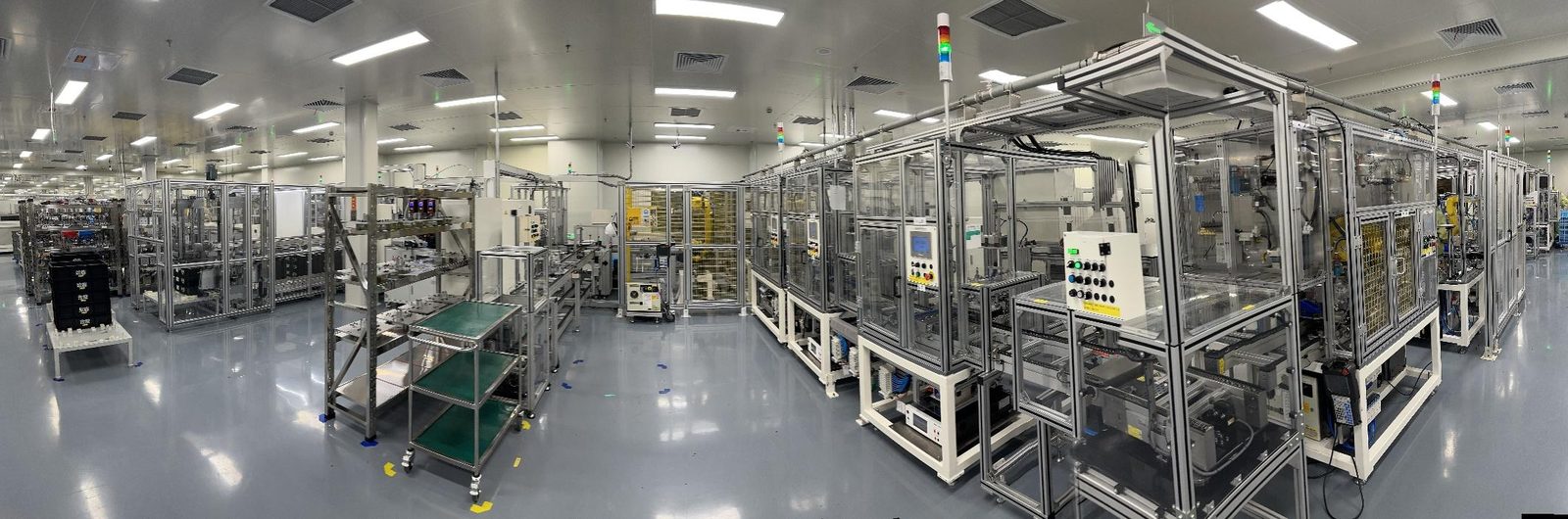
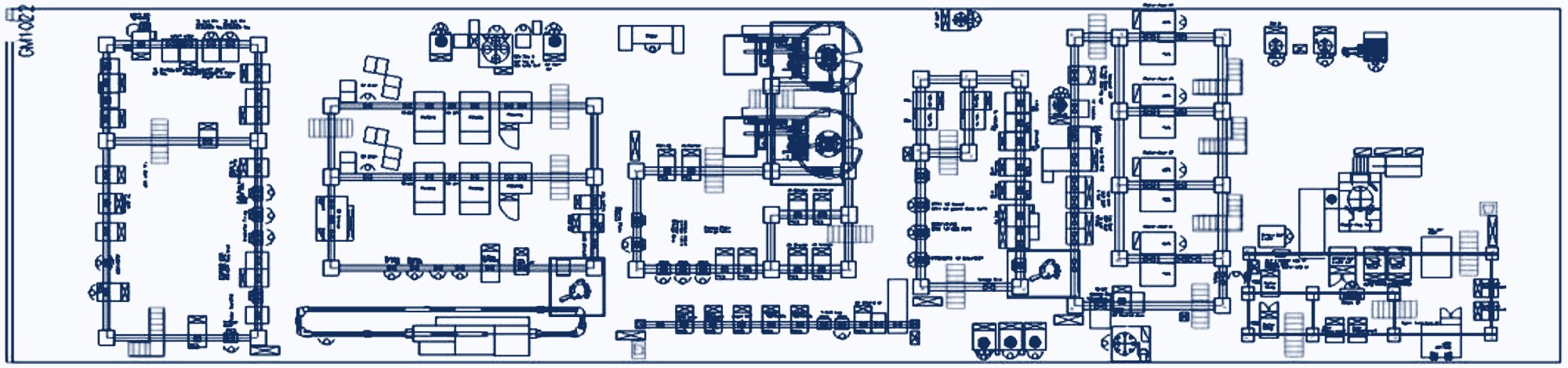
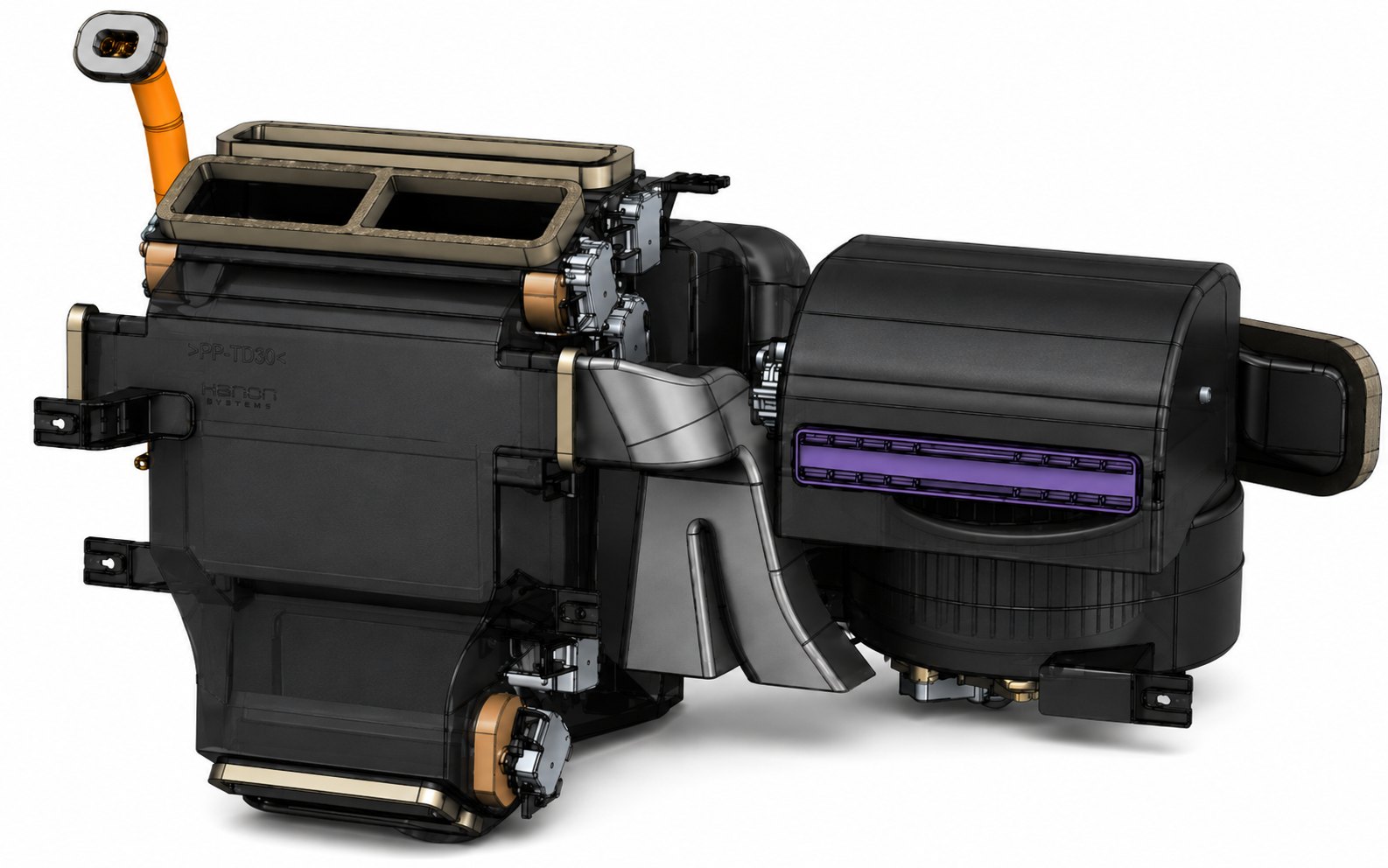
HVAC box assembly line
Twenty-three stations taking an automotive HVAC unit from evaporator core pre-assembly all the way to line-off, with four inspection machines built into the line.
- Evaporator core pre-assembly through to completion and offline in one continuous flow
- Core leak detection integrated in-line
- Air-velocity testing to verify airflow performance
- Missing and incorrect part detection before the unit advances
- Noise testing as a final quality gate
- Line cycle time
- 90 s
- Stations
- 23
- Operators
- 23 per shift
- Test machines
- 4
Full production line · Export program
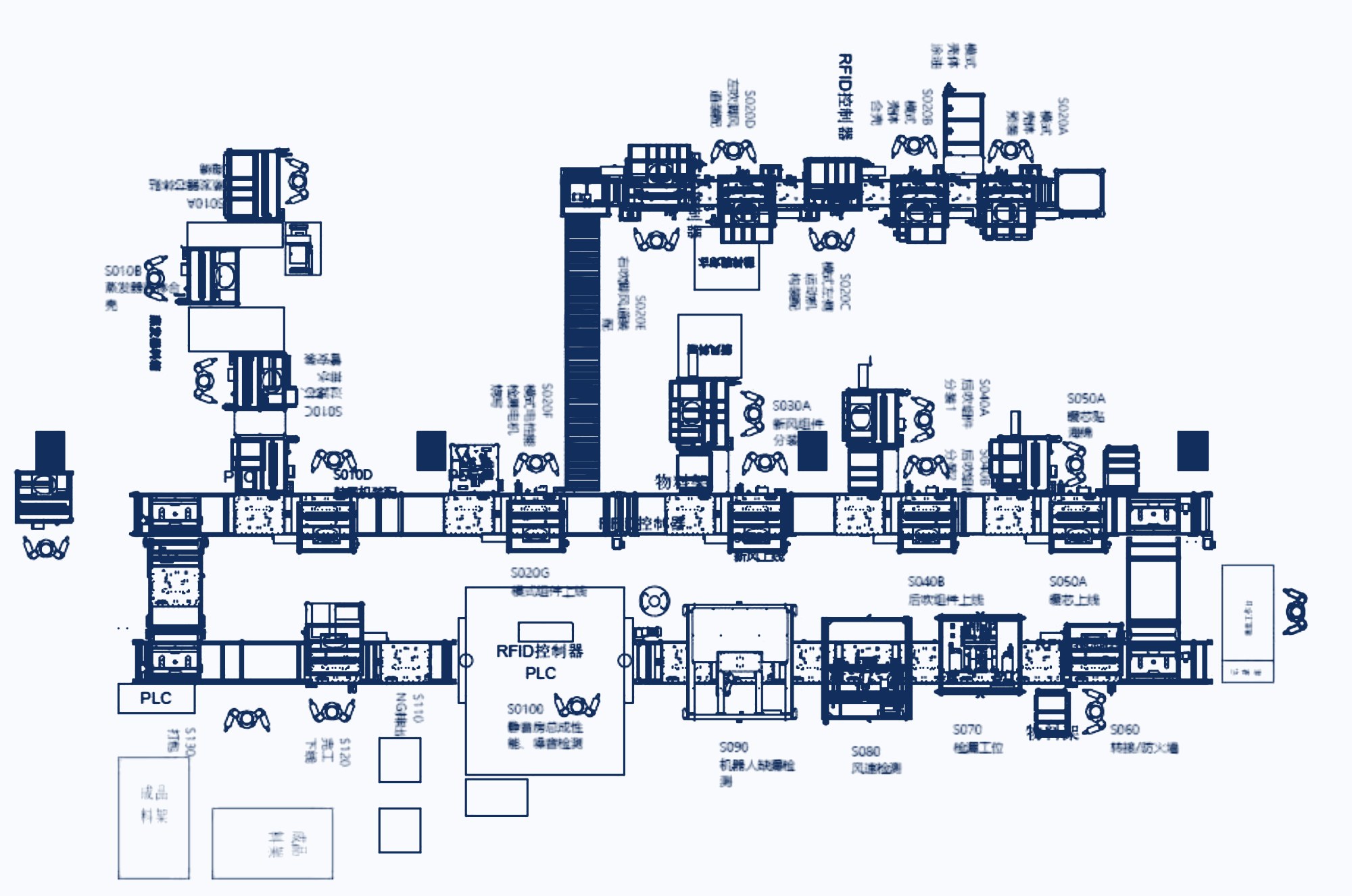
HVAC box assembly line — Mexico
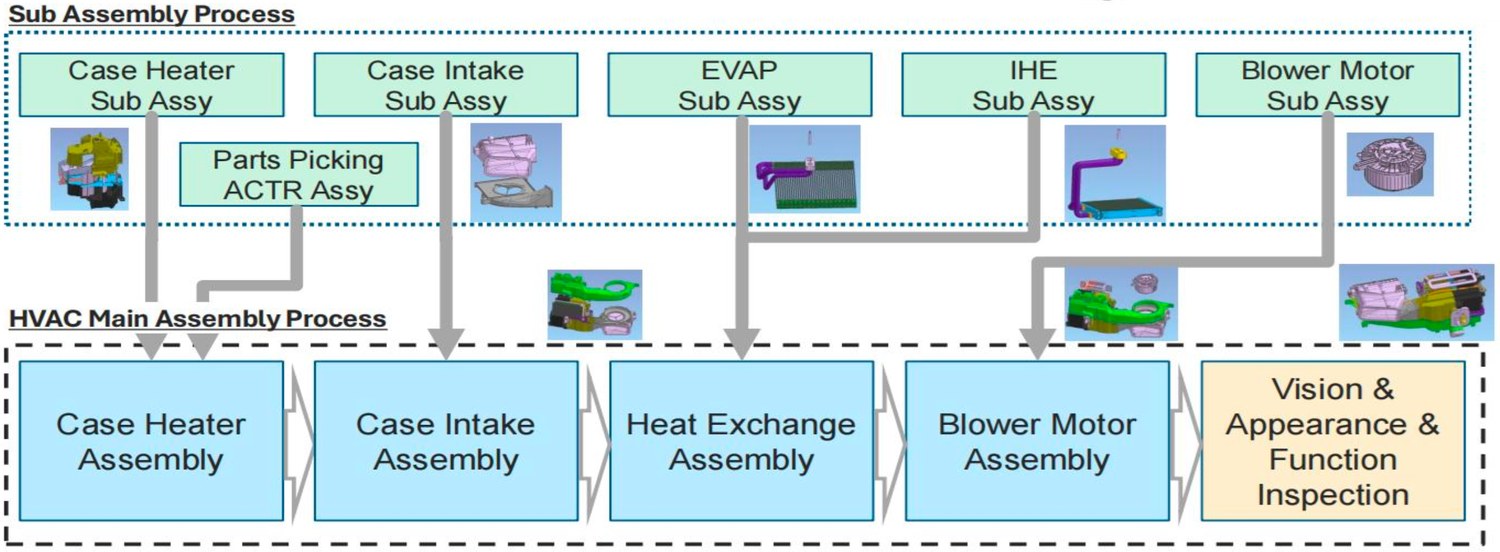
The same HVAC assembly program delivered to a customer plant in Mexico: five sub-assembly streams feeding a five-stage main assembly process, ending in combined vision, appearance and function inspection.
- Sub-assembly: case heater, case intake, evaporator, internal heat exchanger and blower motor, each built on its own stream
- Parts picking for actuator assembly feeds the case heater line directly
- Main assembly sequences case heater, case intake, heat exchange and blower motor
- Combined vision, appearance and function inspection as the single release gate
- Proof that the same line design transfers to a plant outside China
- Destination
- Mexico
- Sub-assembly streams
- 5
- Main assembly stages
- 5
- Final gate
- Vision + function
Full production line
PTC heater production line
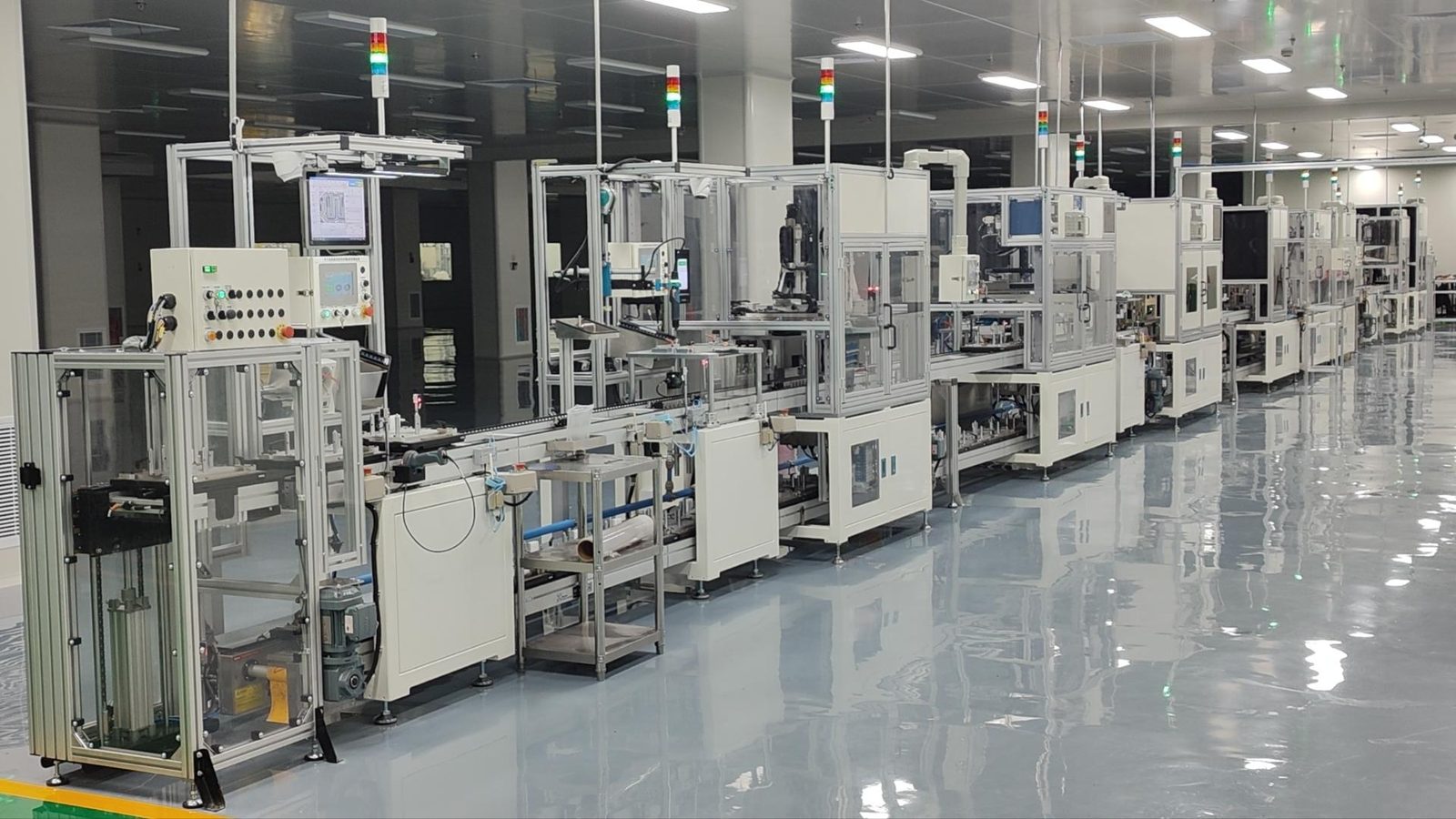
An automated line for PTC cabin heaters, built around thirteen machines with a lean operator count.
- Thirteen linked machines covering assembly and test
- Six operators per shift across the whole line
- Automated transfer between stations with in-process verification
- Line cycle time
- 50 s
- Machines
- 13
- Operators
- 6 per shift
- Scope
- Turnkey line
Line design · Humanoid robot actuators
Humanoid robot joint assembly line
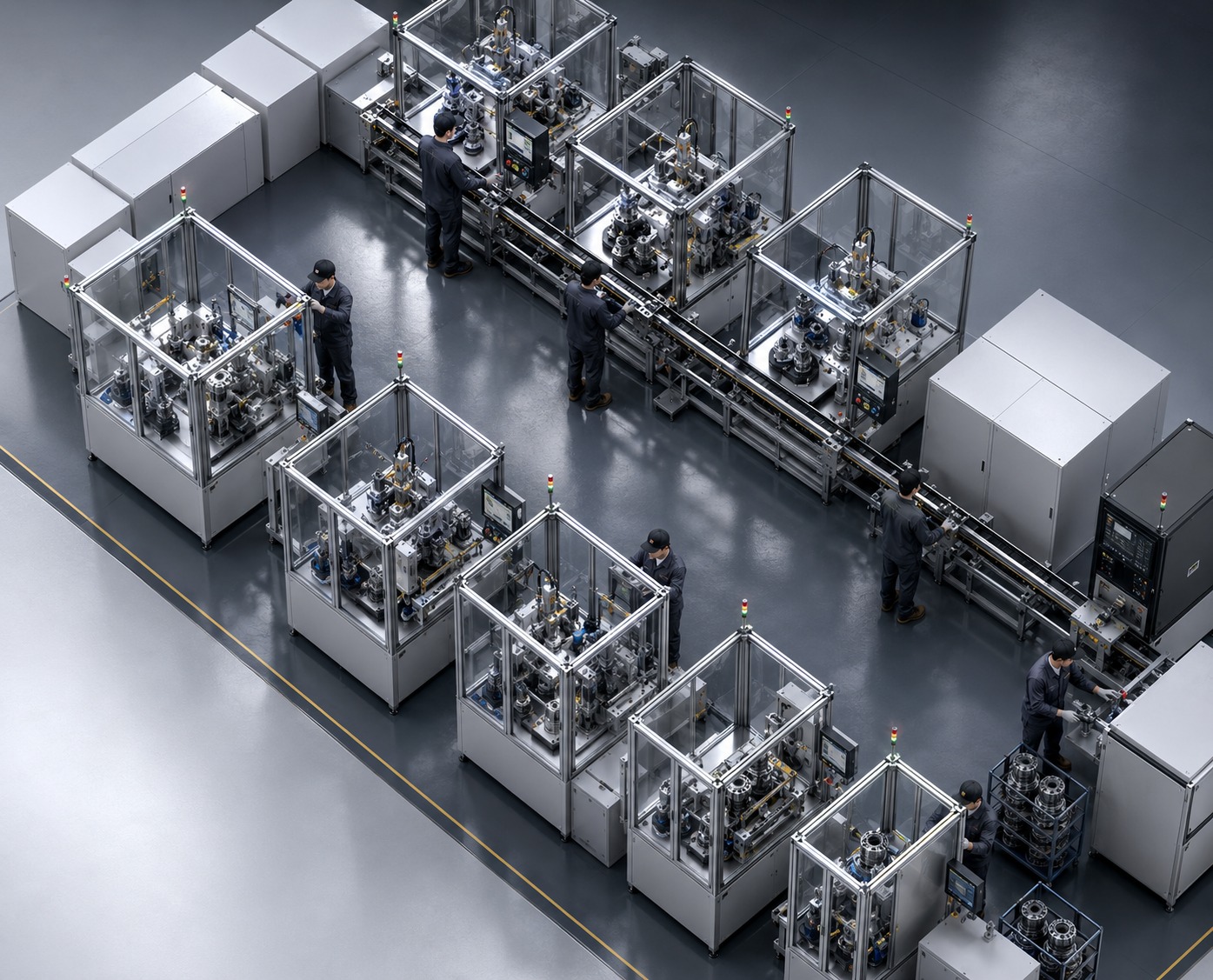
An eleven-station line for harmonic-drive robot joints — the actuator at a humanoid’s shoulder, elbow and knee. Bearing stacking, adhesive-dosed fastening, automatic shim selection, grease dosing and run-in torque characterization, laid out on a 10.2 × 5.5 m footprint.
- Bearing stack built in sequence — thin-wall, ball and angular-contact bearings each pressed onto the input shaft after adhesive is dosed onto its own seat and the bead is camera-verified
- Automatic shim selection: a displacement sensor measures the actual stack height, the system calculates the shim needed, and only that shim magazine opens — an independent gauge then re-checks the shim before it goes in, and the height is measured again after
- Every screw is dipped in thread-locker and brushed clean of excess before driving — 24 at the torque sensor assembly, 14 at the cross-roller bearing, 12 at the output shaft, each station monitored for adhesive presence
- Wave generator press-fitting, then grease dosed into the flexspline cavity and onto the cross-roller bearing teeth
- Run-in station characterizes input-shaft torque across a speed range — the only way to prove a harmonic joint was assembled correctly
- DMC bound to the pallet at the first station, laser-marked at the last, and the code graded by scanner rather than merely read
This is an engineered line design, not yet a system in production — shown here because it is the clearest answer to what robot joint assembly actually requires.
- Stations
- 11 · OP10–OP110
- Footprint
- 10.2 m × 5.5 m
- Flow
- Pallet loop, U-cell
- Status
- Engineered 2026
Specialized test station
AI-based NVH test equipment
A noise and vibration test station that reads the product the way an experienced inspector does — and does it on a production floor, without an acoustic room.
- Real-time acquisition of product sound together with vibration in three directions
- Stethoscope-principle acoustic pickup that is unaffected by surrounding factory noise
- No soundproof enclosure needed — the station drops onto the line and tests within the line cycle
- A deep-learning model separates NG from OK parts in real time, with no operator judgement
- Identifies most categories of missing-part faults, not just overall noise level
- Signals
- Sound + 3-axis vibration
- Acoustic room
- Not required
- Decision
- Real-time NG / OK
- Detects
- Most missing-part types
Retrofit + traceability
Car tailgate riveting equipment
Operator-guided riveting with full curve traceability — achieved by modifying the existing riveting gun rather than replacing the process.
- Step-by-step operator prompting through the entire riveting sequence
- The Böllhoff riveting gun modified to expose process signals
- Advantech acquisition cards capture the riveting curve for every joint
- Curves stored and traceable — the data problem solved without a new machine
- Approach
- Retrofit
- Rivet gun
- Böllhoff, modified
- Acquisition
- Advantech cards
- Output
- Curve per joint
Single-operator workstation
Quick-connect coupling assembly & test workstation
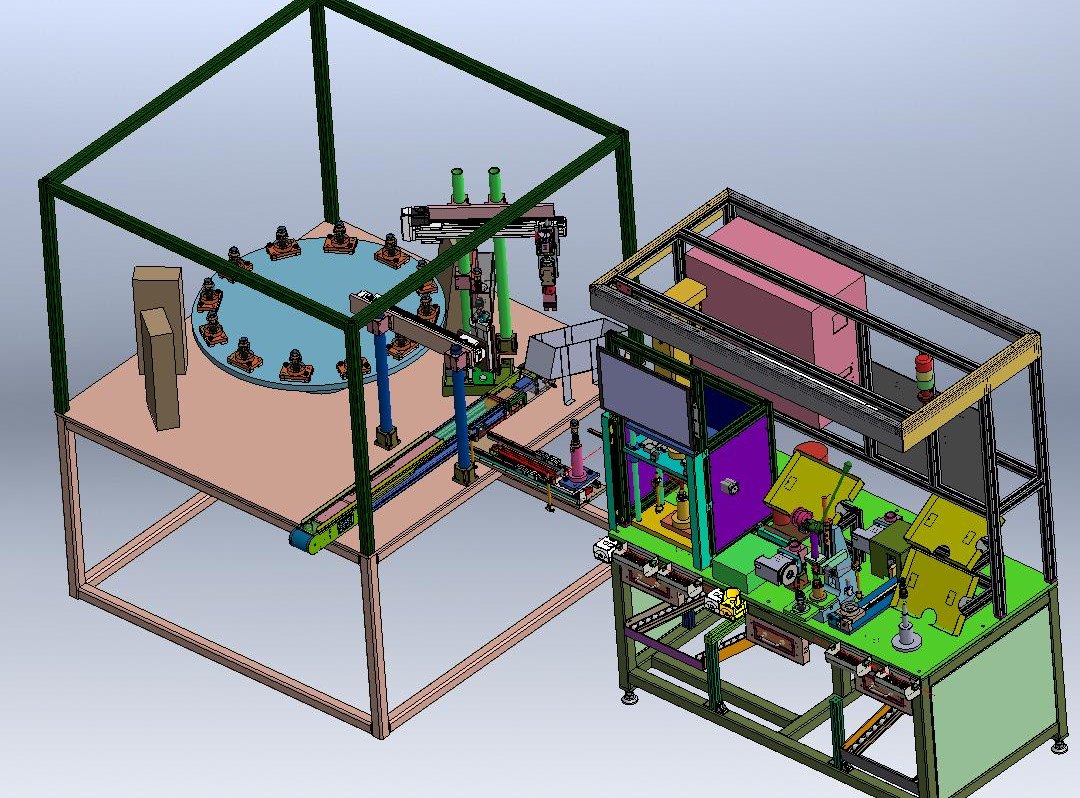
A compact workstation built around a twelve-station rotary table, running two product variants with error-proofing designed in from the first drawing.
- Camera-based mixed-part prevention between two visually similar variants
- Interlocked poka-yoke signal chain — the next step is blocked until every prior signal is satisfied, with a separate recipe per variant
- Servo press-fitting with vacuum part-holding and negative-pressure monitoring
- Pneumatic precision gauging with calibration certificate and temperature compensation
- NG parts segregated by defect class: mixed part, dimensional, press-fit
- The same program modernized the customer's existing rotary test machine — new servo loading gantry, quick-change dial fixtures, oil-spray station, DMC verification and OK/NG offload
- Layout
- 12-station rotary
- Variants
- 2
- Operators
- 1
- Changeover
- Minutes
Robotic work cell
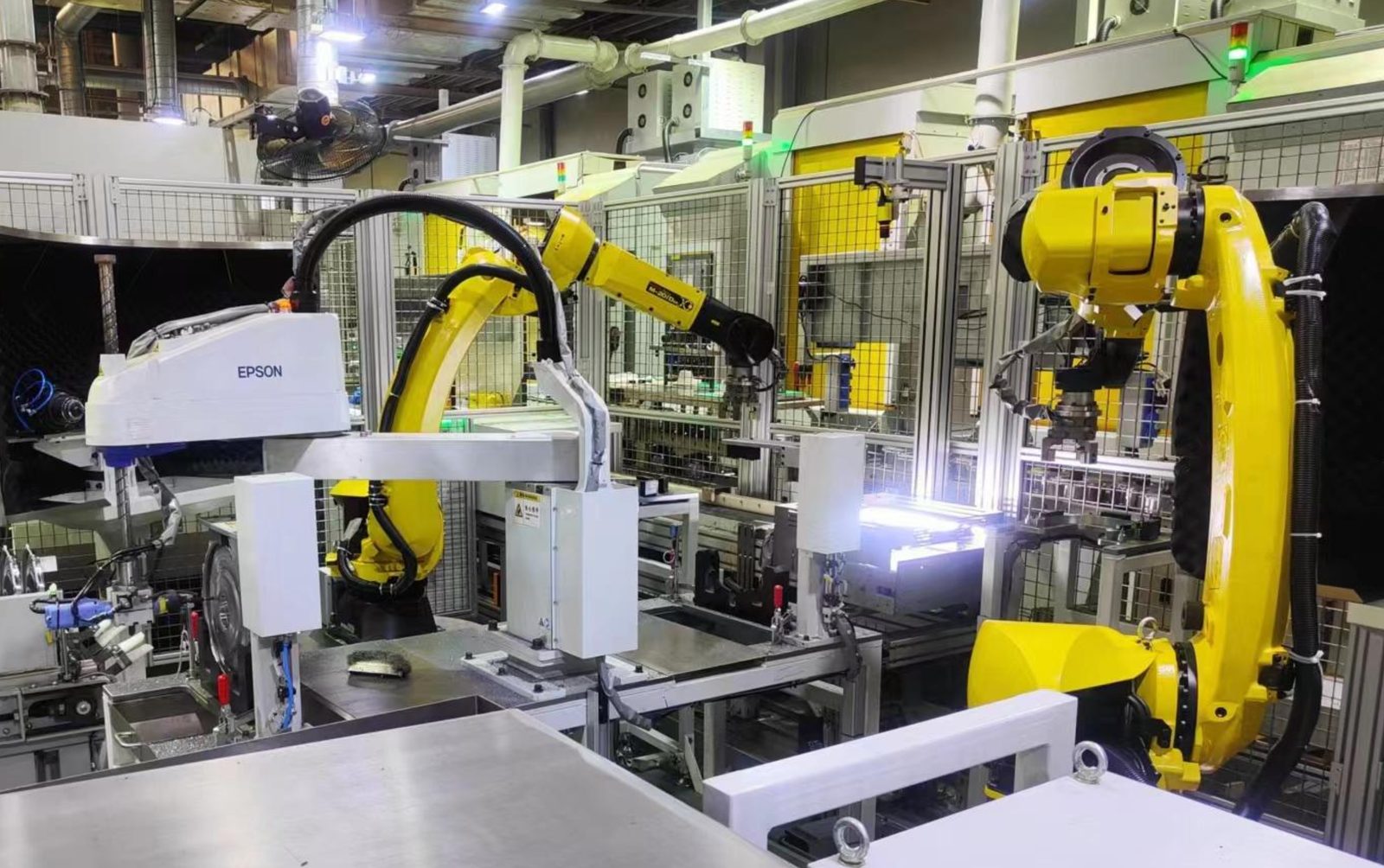
Robotic deburring cell
A fenced cell combining a SCARA and a six-axis robot to take deburring off the operator entirely, running three shifts a day.
- Force-compliant tooling follows the burr, absorbing part-to-part positioning variation
- SCARA handling paired with a six-axis robot for the finishing pass
- Safety-fenced layout with operator load/unload outside the working envelope
- Robots
- SCARA + 6-axis
- Tooling
- Force-compliant
- Duty
- 3 shifts
- Material
- Cast iron / bearings
Smart factory software
MES for machining production lines
Manufacturing execution deployed across multiple machining lines — the layer that turns machine data into something a plant manager can act on.
- System management and production planning
- Master data maintenance across products and processes
- Process management tied to the actual station sequence
- Quality data collection and analysis across the machining fleet
- Scope
- Multiple lines
- Modules
- Planning + process
- Data
- Quality analysis
- Layer
- Between ERP and machines
Your process, on this list.
Every system on this page was quoted from the same three inputs: a product, an annual volume and a cycle time. That is where yours starts too.