The engineering underneath the systems
This page describes the technology platform of Linking Automation, our automation partner. Four things decide whether a line holds its cycle time and its quality numbers: error-proofing that stops a bad part at the station, AI inspection that judges in real time, patented mechanisms doing the physical work, and a software layer that records all of it.
Error-Proofing & Traceability
Built so mistakes can't leave the station
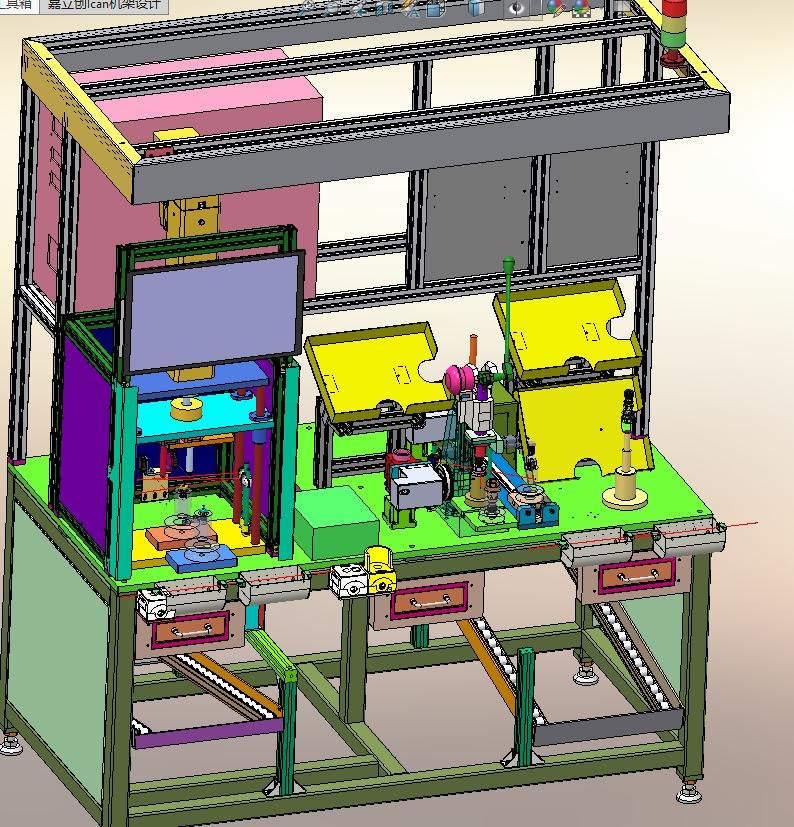
Every cell we supply carries a full poka-yoke architecture: each process step emits a sensor signal, and the next operation is interlocked until every required signal in the chain is satisfied — with a separate signal recipe per product variant.
The clearest example is shim selection on a robot joint line: a displacement sensor measures the actual stack height, the system calculates the shim required, and only that shim magazine opens. An independent gauge re-checks the shim before it goes in, and the height is measured again afterwards — three verifications replacing one operator judgement. See the line.
- Camera-based mixed-part detection between similar variants
- Pneumatic precision gauging (air-electric measurement with calibration certificate and temperature compensation)
- Servo press-fitting with vacuum part-holding and negative-pressure monitoring
- Laser marking with DMC code verification for unit-level traceability
- NG parts segregated by defect class — mixed-part, dimensional, press-fit
Applied AI
AI-driven inspection & NVH testing
The NVH test equipment acquires product sound and three-directional vibration signals in real time. Stethoscope-principle acoustic pickup makes it immune to background noise — no soundproof room required.
A deep-learning model distinguishes NG from OK parts in real time and can identify most types of missing-part faults. Multi-label modeling keeps training data requirements small: ten labels where a conventional approach would need a thousand.
- Deep-learning surface defect detection
- AI-based NVH pass/fail classification
- Riveting curve acquisition & traceability
Why it matters on the line
- No soundproof room — test in-line, within the line cycle
- Real-time NG/OK classification, no operator judgment
- Identifies most missing-part fault types
- Ten training labels instead of a thousand
- Every result logged and traceable per part
Patented
Patented technology behind the systems
Linking Automation holds 15 utility patents and 12 software copyrights. The mechanisms below are a selection.
The Platform
Four systems, one digital factory
Sitting between your ERP/PLM layer and the equipment on the floor, the software platform closes the loop between planning and execution — so a line we deliver reports the same data as the rest of your plant.
Manufacturing Execution System
Planned production, operation instructions, production monitoring, equipment management, quality management, personnel, materials, tooling and fixtures — the backbone of the digital workshop.
Intelligent Warehousing System
Inbound and outbound management, monitoring platform, report center, packaging management and logistics planning.
Manufacturing Data Collection
Device communication, equipment data collection, statistical analysis and fault alarms — live visibility into every machine on the floor.
Distributed Numerical Control
Machine tool communication, NC code management, machine data collection, analysis, control and fault alarms across the machining fleet.
Complemented by a mobile app platform (production analysis, plan achievement rate, quality overview, root-cause analysis) and digital signage feeding back production, material, equipment, personnel and quality status in real time.